


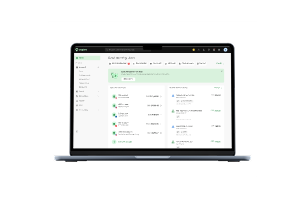
What Green Link Digital Bank offers companies in 2026
Green Link Digital Bank (GLDB) is a MAS-licensed digital wholesale bank in Singapore focused on SMEs involved in regional trade and supply chains. It provides digital banking, working capital financing, and trade support services designed primarily for businesses operating across cross-border commerce corridors.
GLDB's platform focuses on helping companies manage trade flows, cash management, and financing through a digital banking interface rather than traditional branch banking.
Key features of GLDB:
- Business current accounts in SGD and USD with no monthly account fees and no minimum balance requirement
- Multi-currency account structure using SGD and USD sub-accounts for cross-border transactions
- Fixed deposits in SGD and USD with tenors of 6, 9, 12, and 18 months
- Local and international payments, including MEPS transfers, scheduled payments, and overseas transfers with FX support
- Overseas transfer fees from about 1/12% per transaction (minimum around SGD $40 and capped around SGD $150 depending on currency)1
- Working capital financing, including overdraft facilities and business loans, which are subject to credit assessment
- Trade and supply chain financing, including payables financing, receivables financing, and supplier financing structures
- Embedded finance capabilities that allow lending and banking services to integrate into partner platforms or B2B ecosystems
GLDB's services are primarily structured for trade-focused SMEs that require financing and cross-border transaction support, rather than businesses looking for a full operational banking platform with cards, payroll, or expense management tools.
Why businesses search for Green Link Digital Bank alternatives in 2026
Green Link Digital Bank focuses strongly on trade finance and working capital solutions. However, in 2026, some businesses explore alternatives depending on their operational needs and growth stage.
Here are common gaps or considerations that lead companies to compare options:
- Limited currency breadth: GLDB primarily supports SGD and USD accounts. However, businesses operating across Europe, China, or broader Asia may seek multi-currency support beyond these two currencies.
- Fewer ecosystem integrations: Companies using cloud accounting software, payroll platforms, expense management tools, or accounting systems may require deeper API integrations and automation capabilities, which GLDB currently does not provide.
- Credit eligibility criteria: While GLDB offers overdrafts, term loans, and trade financing, eligibility may depend on trade flow history, invoice quality, or credit standing. Early-stage startups without trade activity may not qualify for certain facilities.
- Different operational priorities across business stages: GLDB is designed primarily for trade-oriented SMEs. Businesses that prioritise international payments, multi-currency accounts, team spending controls, or integrated financial operations may compare other fintech platforms or banks that offer those capabilities.
Quick comparison of Green Link Digital Bank alternatives in 2026
Before diving into the details, here's how the leading GLDB alternatives stack up across the factors that matter most to Singapore-based SMEs, startups, and growing mid-size companies:
Data as of March 2026. Note: Fees and features are subject to change. Confirm current rates directly with each provider before committing.
Best GLDB alternatives for Singapore businesses in 2026
ANEXT Bank
ANEXT Bank is a digital wholesale bank licensed by the Monetary Authority of Singapore. Launched in 2022 and backed by Ant International, the bank focuses on providing banking and financing solutions for SMEs, particularly those involved in cross-border trade and supply chains. The platform operates fully online with digital onboarding and no physical branches.
What it offers
- Business account: No minimum balance and no monthly account fee
- Multi-currency support: Hold balances in SGD, USD, CNH, and EUR4
- Interest on balances: Eligible SGD, USD, and EUR balances may earn daily interest
- Business financing: Access to loans, trade financing, and supply chain financing solutions
- Digital onboarding: Accounts can be opened and managed fully online
- Local transfers: SGD transfers within Singapore are typically free
Pricing
The ANEXT business account has no setup fee, no monthly fee, and no minimum balance requirement. Foreign exchange services are available for supported currencies, and pricing may include an FX margin depending on the transaction2.
Considerations
The platform focuses mainly on trade financing and cross-border business activity rather than daily spend management. It does not currently provide corporate cards, expense management tools, or direct integrations with accounting platforms such as Xero or QuickBooks. Cross-border transfers generally use SWIFT, which may be slower or more expensive than some fintech alternatives.
MariBank
MariBank is a digital bank backed by Sea Group, the parent company of Shopee and Garena. It received its digital bank licence from the Monetary Authority of Singapore in 2020. MariBank provides banking services for both individuals and businesses and is particularly relevant for companies already operating within the Sea ecosystem.
What it offers
- Interest on balances: Earn 1% p.a. interest on the full SGD balance, with interest credited daily
- Free local transfers: Send payments to staff and suppliers through FAST and PayNow with no local transfer fees
- Global remittances: Send money to 40+ destinations in about 20 currencies, with promotional SGD $0 transfer fees until June 2026 and competitive FX rates
- Business financing: Access unsecured loans of up to SGD $200,000 through a revolving credit line or up to SGD $500,000 through term loans5
- Shopee integration: Sellers can withdraw their Shopee Seller Balance daily without fees, which may help improve cash flow
Pricing
Opening a MariBank account comes with SGD 0 setup fees, no monthly maintenance charges, no minimum balance requirement, and no fees for falling below the minimum balance.
Considerations
International transfer options and multi-currency capabilities are more limited compared with some fintech platforms. Foreign exchange costs and overseas transfer fees may vary depending on the destination. The platform also lacks advanced spend management features, including corporate cards and invoice management. Its integrations with accounting software or APIs are relatively basic.
DBS Bank
DBS Bank is Singapore's largest bank and offers a wide range of business banking services for companies of different sizes. Its SME banking segment provides business accounts, financing, trade services, and payment solutions designed for small and medium-sized enterprises. Businesses can manage accounts through digital banking platforms while also accessing in-branch services when needed.
What it offers
- Business accounts: SGD and foreign currency accounts for daily operations
- Financing solutions: Business loans, working capital facilities, and trade finance
- Cash management: Payment collection, treasury, and liquidity management services
- Relationship support: Dedicated relationship managers for growing SMEs
- Government integrations: Direct connectivity with CPF and IRAS payment systems
- Branch access: Extensive physical branch network across Singapore
Pricing
The Business Multi Currency Account – Starter Bundle (for businesses under three years old) has an SGD $10 monthly fee with no monthly service charge. The Business Multi Currency Account (for businesses over three years) charges SGD $50 annually and includes an SGD $40 monthly service charge3. Foreign exchange fees may apply depending on the transaction, although some card transactions may have reduced FX charges.
Considerations
Monthly service fees and fall below charges may apply, depending on the account type. Account opening and compliance checks can also take longer compared with some fintech platforms.
OCBC Bank
OCBC Bank provides business banking services for SMEs and larger companies in Singapore. Its offerings include business accounts, lending, treasury services, and payment solutions, with additional support for businesses in specific sectors such as retail, food and beverage, and trading.
What it offers
- Business accounts: SGD accounts for daily business payments and collections
- Industry support: Sector-specific desks for industries such as retail and F&B
- Financing solutions: Business loans and credit facilities for SMEs
- Treasury services: Cash flow and liquidity management solutions
- Relationship support: Dedicated relationship management for business clients
- Government integrations: Support for CPF and IRAS-related payments
Pricing
The Business Growth Account requires an initial deposit of SGD $1,000 and charges SGD $10 per month. The Business Entrepreneur Account Plus requires an initial deposit of SGD $30,000 and does not charge a monthly account fee6.
Considerations
Minimum balance requirements and monthly fees may apply depending on the account selected. Foreign exchange spreads and international transfer fees may also be higher than those offered by some fintech platforms.
UOB Bank
United Overseas Bank (UOB) provides business banking services across ASEAN markets, including Singapore, Malaysia, Thailand, and Indonesia. The bank offers several business account options for companies managing domestic payments and cross-border transactions.
What it offers
- Business accounts: Current accounts and foreign currency accounts for businesses
- Regional banking: Presence across ASEAN markets supporting regional operations
- Trade services: Trade finance and cross-border payment solutions
- Financing options: Working capital and business loan facilities
- Cash management: Payment collection and liquidity management tools
Pricing
The UOB eBusiness Account and Corporate Current Account charge SGD $35 annually. Minimum opening deposits typically start from SGD $1,000, depending on the account type7. Foreign currency accounts generally do not charge a monthly fee, although minimum balance requirements may apply.
Considerations
Monthly service fees or fall-below charges may apply if balance requirements are not met. Foreign exchange spreads and international transfer costs may also be higher than those offered by some fintech platforms.
Aspire
Aspire provides financial tools designed for businesses in Singapore. It is regulated by the Monetary Authority of Singapore. The platform combines multi-currency business accounts with spend management features in one interface.
What it offers
- Multi-currency accounts: Hold and receive payments in 30+ currencies across 130+ countries, with local account details in SGD, USD, EUR, GBP, MYR, PHP, IDR and VND
- Transparent FX pricing: Currency exchange rates start from 0.22%, with fees shown before confirming transactions
- Local payment support: Supports PayNow, FAST, GIRO, payroll, CPF contributions, and corporate tax payments
- Corporate cards: Issue up to 200 virtual and physical cards on the basic plan, with 1% cashback on eligible marketing and SaaS spend
- Expense management: Create budgets by team, project, or client, with approval workflows and real-time spend tracking
- Accounting integrations: Sync with Xero, QuickBooks, Oracle NetSuite, Deskera, and SAP
- Yield option: Earn returns on SGD and USD balances through money market funds, with next business day withdrawals and no minimum balance
Pricing
There are no monthly account fees, no account opening charges, and no minimum balance requirements. Domestic transfers through FAST and GIRO are free, and international transfers use mid-market exchange rates with a markup starting from 0.22%, shown upfront before completing the transaction.
Considerations
Aspire is not a traditional bank and does not provide lending services or deposit insurance. Some advanced tools and features may be available only under higher-tier plans.
Key factors to evaluate when choosing a business financial services provider in 2026
If you are planning to switch, review these factors carefully before opening a new account:
1. Understand the FX pricing model
Foreign exchange costs can add up, especially when processing large volumes.
Check:
- Does the provider use the mid-market rate or apply a markup?
- Are there extra charges on weekends?
- Is pricing structured in tiers with monthly limits?
- Are all fees clearly shown before you confirm a transaction?
2. Evaluate the total cost, not just the monthly fee
Examine your expected usage pattern and calculate the actual cost.Review the full fee structure, including:
- Monthly subscription fees
- FX markup percentage
- Card foreign transaction charges
- International transfer fees
- ATM or withdrawal fees
3. Confirm local payment capabilities
If your business primarily operates in Singapore, make sure the platform supports essential local rails such as:
- PayNow
- FAST and GIRO
- CPF contributions
- Salary payments
- Corporate tax payments
4. Assess expense management features
For growing teams, strong spending controls are important.
Check whether the platform provides:
- Budget limits by team or project
- Structured approval workflows
- Virtual and physical corporate cards
- Real-time transaction tracking
- Receipt capture and reconciliation tools
5. Consider scalability and global capability
Your banking partner should support your growth. Switching again in a year due to growth constraints can be disruptive.
Ensure the platform can manage:
- Higher transaction volumes
- Multi-currency holding accounts
- Local receiving details in key markets
- Batch payments or mass payouts
- API access for automation
6. Check accounting integrations
Manual reconciliation increases the risk of errors and adds administrative burden. Automation can reduce accounting workload and improve accuracy.
Look for:
- Direct integration with Xero, QuickBooks, or your accounting system
- API connectivity
- Automated and frequent data synchronisation
7. Review regulatory status and safeguards
Cost should not outweigh compliance and security.
Before moving, verify:
- Licensing status in Singapore or other locations where you operate
- How do they safeguard your (client) funds
- Whether deposit insurance applies
- Data security and compliance standards
Ready to move beyond Green Link Digital Bank
As your company grows, you may need more than structured working capital. Many businesses also look for broader multi-currency support, corporate cards for teams, accounting integrations, and simpler expense management.
For businesses in Singapore, Aspire combines a business account, corporate cards, invoice management, payments, and expense controls into a single platform. This allows companies to manage spending, cash flow, and international transfers from a single dashboard, rather than using multiple tools.
So, let's get started, open an account right away.
Frequently asked questions
What is the difference between GLDB or ANEXT and MariBank or GXS?
The main difference lies in their product offerings and target customers. Green Link Digital Bank and ANEXT Bank are digital wholesale banks that mainly serve small and medium businesses with services such as business accounts, financing, and cross-border trade support. In contrast, MariBank and GXS Bank are digital banks focused primarily on retail customers and small businesses, offering simpler accounts, savings features, and basic payment services. All four are licensed and regulated by the Monetary Authority of Singapore, but their products are designed for different customer types.
Which bank is cheaper for a business account?
Among digital banks in Singapore, ANEXT Bank and Green Link Digital Bank are generally among the more cost-efficient options for SMEs. Both offer SGD $0 monthly account fees, no minimum balance requirements, and no initial deposit, which keeps fixed account costs low compared with many traditional business banking options. These banks are primarily designed for SMEs and may also offer services such as SME financing and trade-related support.
Beyond digital banks, several fintech platforms can also offer cost-efficient alternatives depending on how the account is used. Aspire, for example, combines multi-currency accounts with strong local payment infrastructure, such as PayNow, FAST, and GIRO, as well as international transfer capabilities. Wise Business is often chosen for cross-border payments and foreign exchange, where competitive FX pricing can help reduce international transfer costs. Ultimately, the most affordable option depends on whether your business mainly handles local payments or international transactions.





.webp)