

.png)
What is account management
Account management involves building and maintaining relationships with clients, coordinating internal resources to deliver quality work, and driving business growth through a deep understanding of client goals and objectives. Simply put, it is a critical component of agency success, requiring a nuanced understanding of both the client's needs and the agency's capabilities to deliver steady revenue or cash flow.
At its core, effective account management requires a unique blend of strategic thinking, communication skills, and project management expertise. Most importantly, agencies should focus on delivering consistent value to their clients in innovative ways that build trust and grow business through:
- Offering continued training on the company's product or service offerings
- Providing on-demand expertise and advice
- Delivering exceptional customer service
- Creating consistent value-adds to existing product or service offerings, such as after-sales care and warranties.
When done right, account management becomes a steady driver of revenue and cash flow rather than a purely operational function.
Importance of effective account management
For many organisations, the well-known principle holds true: a small percentage of clients often generate a large share of total revenue. However, too often, companies don't have a dedicated process to nurture those key business relationships. All too often, this leads to a loss of cash flow, and agencies are forced to spend precious liquidity to either regain lost clients or onboard new ones.
The work isn’t done when the sale closes. Customers big and small leave for many reasons, and one of the best ways to avoid a negative impact on your financial bottom line is to implement a strategic account management program. Along with keeping your clients happy with your services, a strong agency-client relationship can help you:
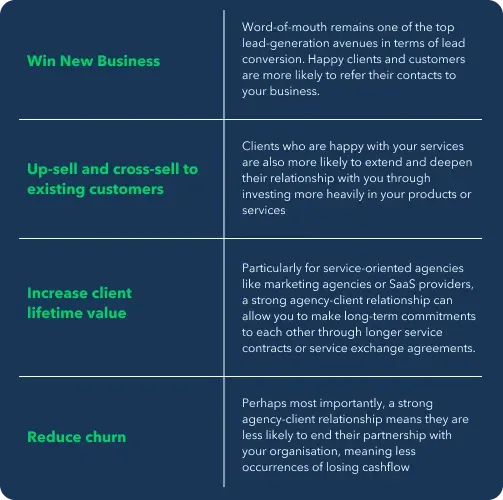
The entire process is usually the responsibility of dedicated account managers, who, in addition to strong customer service skills, should also be adept at handling multiple simultaneous accounts.
The account manager role
The account manager sits at the intersection of client expectations and internal delivery. Whether in an advertising, marketing, or SaaS environment, effective account managers understand client needs, anticipate challenges, and proactively engage at critical moments.
Account managers are responsible for:
- Acting as the primary point of contact for clients
- Coordinating internal teams to deliver on commitments
- Identifying risks, opportunities, and growth potential within accounts
- Maintaining service quality while balancing operational realities
As a rule of thumb, account managers should:
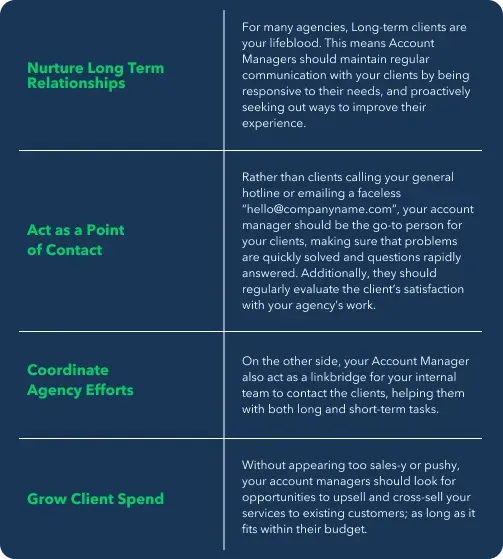
When reviewing the duties required of an account manager, it becomes clear that they need to wear many hats; from being a communicator, to a project manager, to a sales representative.
Common challenges in account management
Strategic account management is a delicate balancing act. Account managers must keep clients satisfied, ensure timely payments, and align internal teams, often with limited time and resources.
Common challenges include:
- Thinking like a vendor: Vendors are replaceable. Agencies that position themselves as strategic partners, aligned with client goals, are harder to substitute.
- Relying too heavily on instinct: While experience matters, scalable account management requires defined processes, data, and consistent workflows.
- Being reactive: Firefighting operational issues can crowd out strategic conversations, leading to missed value-creation opportunities.
- Limited resources: Smaller teams may struggle to prioritise high-value clients effectively.
- Data everywhere, insight nowhere: Disparate systems prevent a single, accurate view of customer financial health, weakening forecasting and credit decisions.
- Too many contracts, too little clarity: Varied SLAs and commercial terms across clients complicate tracking, billing accuracy, and performance measurement.
- Cash tied up, growth slowed: Inconsistent monitoring and long payment cycles, often averaging 54 days or more, create liquidity strain and restrict reinvestment.
Across these challenges, time remains the most consistent constraint.
Account management best practices in 2026
With the right framework, agencies can elevate client relationships and improve retention. Key best practices include:
Embrace clarity in roles
Clearly define responsibilities across account management, customer success, and sales to avoid overlaps and confusion.
Break down communication silos
Encourage information sharing across teams to ensure continuity and avoid duplicated effort.
Improve cross-functional collaboration
Regularly engage sales, operations, and finance teams to deliver consistent client experiences.
Focus on account metrics
Move beyond intuition by tracking client health using metrics such as retention rates, satisfaction scores, and revenue growth.
Automate to eliminate friction
Replace spreadsheets with integrated systems for billing, reporting, and reconciliation. Automation reduces manual errors, accelerates month-end close, and improves reporting reliability.
Create a single source of Information
Integrate financial, operational, and customer data into a unified set of dashboards. A consolidated view enables accurate forecasting, early risk detection, and better credit and renewal decisions.
Develop selection criteria for key accounts
Not all clients require the same level of attention. Identify strategic accounts based on factors such as revenue potential, growth alignment, and long-term fit, with senior leadership guiding this process.
Embed compliance into workflows
Establish structured reviews for tax, regulatory, and cross-border obligations. Compliance should be built into processes rather than treated as a periodic exercise.
Invest in technology and talent together
Adopt AI-driven analytics and automation tools, but pair them with continuous skill development. Upskilling teams ensures technology enhances judgment rather than replacing it.
Connecting account management with the finance function
When it comes to account management, time is always an issue. Account managers should be dedicating the majority of their time to nurturing and deepening the relationship between their organisation and the client. However, many find themselves having to dedicate extensive time and effort to tracking finances for each individual project or client they manage, as well as managing multiple internal or external campaigns.
To free up your account managers' time and allow them to dedicate hours to their clients, it's important to ensure they have strong foundational support from your finance team. This is all the more important as both teams should already be aligned on business goals: drive revenue growth and win or keep customers. Too often, these teams are not collaborating to achieve these goals because they are working on different systems and not communicating with one another. In a world where customer experience and retention have never been more important, a situation like this could be detrimental to your business.
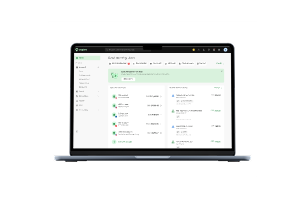
Aspire all-in-one platform can help solve all these issues by integrating seamlessly with your client management operations, freeing up your time by helping you track and automate project finances and spend limits across hundreds of clients simultaneously. With Aspire, you can allocate and track spending down to the project or client level, providing your AM team with a strong, healthy connection to your finance team moving forward.
With having to spend less time on paperwork, budgeting or tracking, you can spend more time on what's truly important – your clients.





.webp)